
Fake Divorce Papers: 7 Red Flags You Need to Spot Before It's Too Late
- brookthibault
- Nov 4, 2025
- 6 min read
Divorce proceedings are already stressful enough without having to worry about fraudulent paperwork or scam artists preying on vulnerable individuals. Unfortunately, fake divorce papers and divorce-related scams have become increasingly common, targeting people who are emotionally vulnerable and may not be familiar with proper legal procedures.
If you're going through a divorce in Virginia, understanding how to spot fake documentation can save you from financial loss, legal complications, and additional emotional trauma. Here are seven critical red flags that should immediately raise your suspicions about the authenticity of divorce papers.
Red Flag #1: Missing or Incorrect Official Court Seals and Headers
Legitimate divorce papers filed in Virginia courts will always contain specific formatting and official markings that scammers often get wrong or omit entirely.
What to look for:
Official court letterhead with the correct courthouse name and address
Properly formatted case numbers that follow Virginia's court numbering system
Official court seals that are clear and properly positioned
Judge's signature or electronic filing stamps
Virginia courts have standardized formats for all divorce documentation. If papers look like they were created on a home computer with generic fonts, lack official seals, or contain spelling errors in the court name or address, you're likely dealing with fraudulent documents.
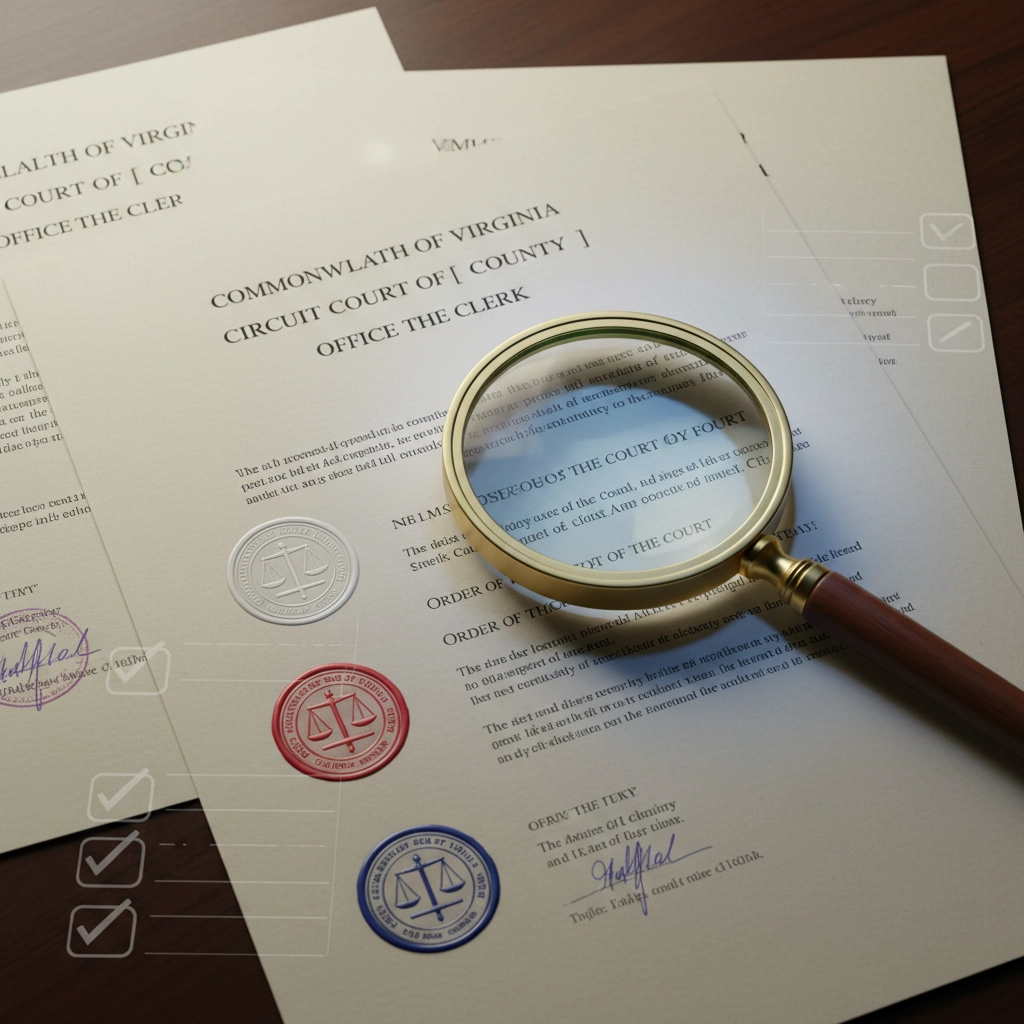
Verification tip: You can always contact the clerk of court directly to verify whether papers were actually filed. Legitimate courts will have records of all filed cases that you can confirm by providing the case number.
Red Flag #2: Unrealistic Timelines or Impossible Dates
Virginia has specific legal requirements for divorce proceedings, including mandatory waiting periods and proper notice requirements that scammers often ignore or misrepresent.
In Virginia, there's a mandatory separation period before you can file for a no-fault divorce:
12 months if you have minor children
6 months if you have no minor children and have signed a separation agreement
Warning signs include:
Papers claiming you can get divorced immediately without meeting separation requirements
Service dates that don't allow proper response time (Virginia requires at least 21 days for response)
Court hearing dates scheduled impossibly soon after filing
Documents dated in the future or with inconsistent date formatting
If someone promises you can "skip the waiting period" or complete your divorce in just a few days, they're either lying about Virginia law or operating outside the legitimate legal system.
Red Flag #3: Suspicious Attorney or Court Contact Information
Legitimate divorce papers will always include accurate contact information for the representing attorneys and the court. Scammers often provide fake contact details or use information that doesn't check out.
Red flags to watch for:
Generic email addresses (like Gmail or Yahoo) instead of professional law firm domains
Phone numbers that go to voicemail systems with no law firm identification
Addresses that don't correspond to actual law offices
Attorney names that aren't licensed to practice in Virginia
How to verify:
Check the Virginia State Bar website to confirm attorney licensing
Google the law firm address to ensure it's a real office
Call the number directly and ask specific questions about your case
Remember, legitimate attorneys are required to be licensed in Virginia to handle divorce cases here. You can easily verify any attorney's license status through the Virginia State Bar's website.

Red Flag #4: Unusual Payment Demands or Methods
How and when you're asked to pay for divorce services can be a major indicator of legitimacy. Scammers often use high-pressure tactics and request payment through untraceable methods.
Warning signs:
Demands for full payment upfront before any work begins
Requests for payment via wire transfer, gift cards, cryptocurrency, or cash only
Refusal to provide written fee agreements
Prices that seem too good to be true compared to other attorneys
Pressure to pay immediately to "secure your spot" or "beat a deadline"
Legitimate Virginia divorce attorneys typically:
Provide written fee agreements outlining all costs
Accept standard payment methods like checks or credit cards
Offer payment plans for clients who need them
Are transparent about what services the fees cover
Red Flag #5: Improper Legal Language and Terminology
Authentic legal documents follow specific formatting rules and use precise legal terminology. Fake papers often contain language that sounds "legal" but is actually incorrect or nonsensical.
Look out for:
Generic language that could apply to any state (real Virginia documents reference specific state statutes)
Incorrect legal terms or procedures
Poor grammar and spelling errors
Missing required legal clauses or disclosures
Language that sounds overly dramatic or emotional rather than clinical and professional
Virginia divorce papers should reference specific Virginia Code sections, use proper legal formatting, and include all required disclosures about rights and responsibilities. If the language seems off or you don't understand what you're reading, that's a valid reason to seek a second opinion from a legitimate attorney.

Red Flag #6: Missing Case Numbers or Incorrect Jurisdictional Information
Every legitimate divorce case in Virginia receives a unique case number when filed, and papers must be filed in the correct jurisdiction. Scammers often overlook these crucial details.
Essential elements that must be present:
A valid Virginia case number in the proper format for the filing court
Correct court jurisdiction (you typically file where you or your spouse reside)
Proper venue information matching where you actually live
Accurate county or city court designation
In Virginia, you generally file for divorce in the circuit court of the county or city where you or your spouse lives. If papers show you filing in a court hundreds of miles away from where either of you lives, or if there's no case number at all, you're likely dealing with fake documents.
Red Flag #7: High-Pressure Tactics Without Proper Documentation
Legitimate divorce proceedings, while sometimes urgent, always follow proper legal procedures and give you time to understand what you're signing. Scammers rely on pressure and confusion to prevent you from asking the right questions.
Warning behaviors:
Rushing you to sign papers without explaining what they mean
Refusing to let you take documents home to review
Claiming you'll lose your chance if you don't act immediately
Discouraging you from consulting with other attorneys
Using fear tactics about what will happen if you don't comply quickly
What legitimate attorneys do differently:
Encourage you to read and understand all documents
Explain your rights and options clearly
Provide copies of everything for your records
Allow reasonable time for decision-making
Support your right to seek second opinions
Protecting Yourself: Steps to Take If You Suspect Fraud
If you've spotted any of these red flags, don't panic. There are immediate steps you can take to protect yourself:
Stop all payments immediately if you haven't already paid, or dispute charges with your bank if you have
Contact the court directly to verify whether any papers were actually filed
Check attorney licensing through the Virginia State Bar website
Document everything – save all communications, papers, and payment records
Report suspected fraud to the Virginia State Bar and local law enforcement
Consult with a legitimate attorney to understand your actual legal situation
Understanding Virginia's Legitimate Divorce Process
To better protect yourself, it helps to understand what the real divorce process looks like in Virginia. Legitimate divorce proceedings involve specific steps that can't be rushed or skipped:
Meeting residency requirements (at least one spouse must be a Virginia resident for 6 months)
Satisfying separation requirements before filing
Proper service of papers to the other spouse
Mandatory waiting periods for responses
Court hearings scheduled according to the court's calendar
Final decree entry following all proper procedures

When to Seek Professional Help
If you're unsure about any divorce documentation you've received, or if you're beginning divorce proceedings yourself, consulting with an experienced Virginia divorce attorney is always the safest approach. A legitimate attorney can:
Review any papers you've received for authenticity
Explain Virginia's actual divorce requirements for your situation
Protect your interests throughout the process
Ensure all paperwork is properly filed and legally binding
Don't Let Scammers Take Advantage During a Vulnerable Time
Divorce is already one of life's most challenging experiences. You shouldn't have to worry about whether the legal help you're receiving is legitimate. By staying alert to these red flags and knowing how to verify information, you can protect yourself from fraud while focusing on what matters most – moving forward with your life.
If you have concerns about divorce documentation you've received, or if you need guidance on starting legitimate divorce proceedings in Virginia, contact Coastal Virginia Law for a consultation. We can help you understand your rights, verify the authenticity of any papers you've received, and ensure your divorce proceeds according to proper Virginia legal procedures.
Remember, when it comes to something as important as divorce, it's always better to ask questions and verify information than to assume everything is legitimate. Your future depends on getting this right the first time.


Comments